
Use of Best and Most Versatile (BMV) agricultural land in England by ground-mounted solar photovoltaic installations
Key Conclusions
This Report uses the new Predictive Agricultural Land Classification (ALC) map for England, released in April 2026, that, for the first time, distinguishes ALC Grades 3a and 3b and thus allows precise estimation of the amount of Best and Most Versatile (BMV) land (ALC Grades 1 to 3a inclusive) that is being taken up by ground-mounted solar installations in England.
50.9% of all land in ALC categories 1 to 5 is BMV land, and 49.1% non-BMV, but 61.3% of ground-mounted solar is on BMV land and only 38.7% on non-BMV land.
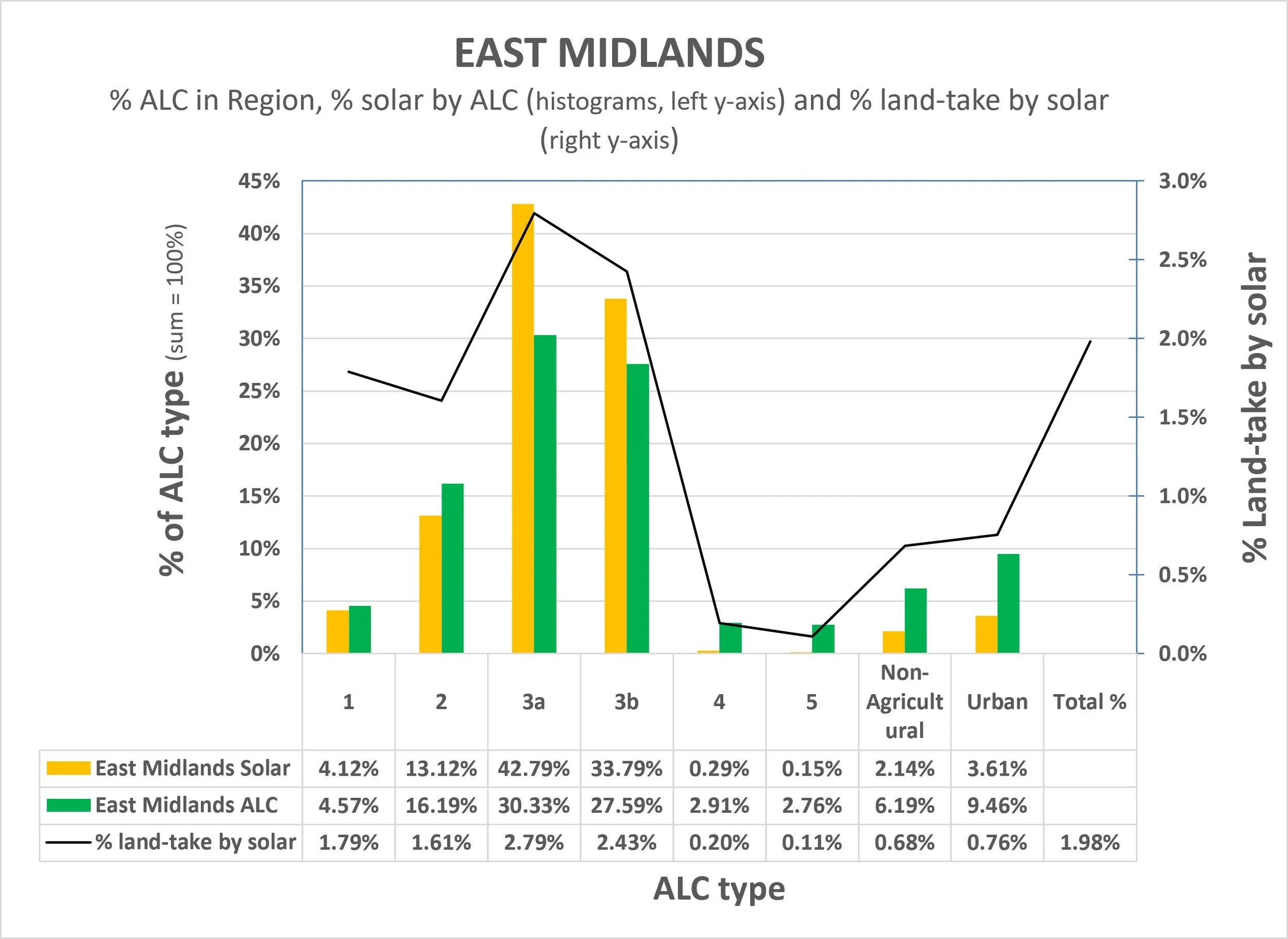
Although the total amount of land currently used by ground-mounted solar in England is a fraction of the total available (c. 0.9%), this figure varies considerably regionally, from only 0.22% in the North West to 1.98% in the East Midlands.
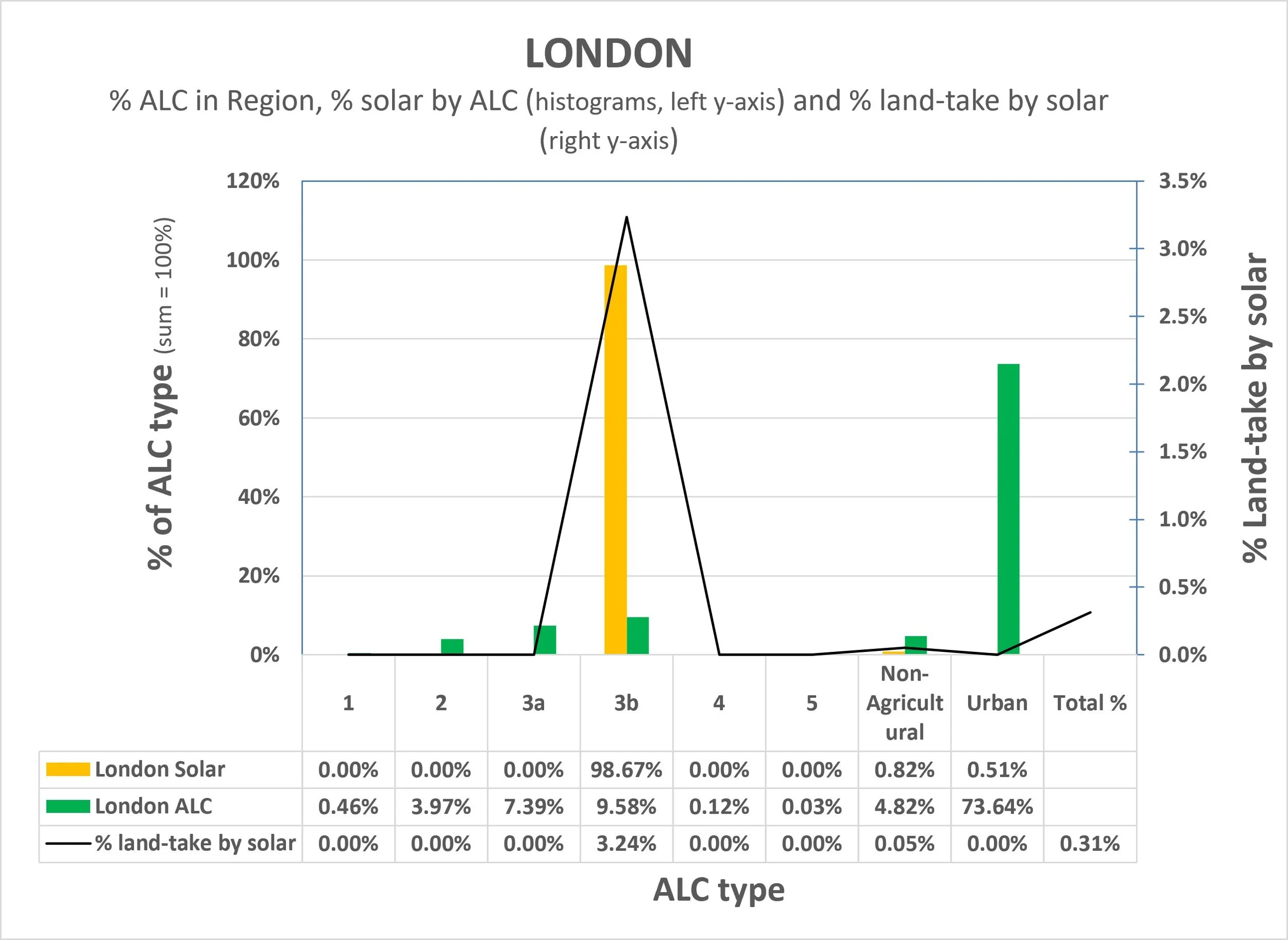
Nation-wide, land-take by solar is higher in the BMV categories (1.25%) than in the non-BMV categories (0.82%). Again, there is a great deal of regional variation, with the greatest discrepancy in the North East (0.90% BMV vs 0.36% non-BMV) and the lowest in the North West (0.21% BMV land vs 0.25% non-BMV land). Solar land-take of BMV land is higher than that of non-BMV land in six out of eight English Regions (the ninth Region, London, has no BMV land). All of this development has been piece-meal, with no overall strategic spatial plan.
Thus, in both relative and absolute terms, ground-mounted solar in England is taking a disproportionately large share of BMV land, in direct contrast to Government recommendations to avoid such land.
The details
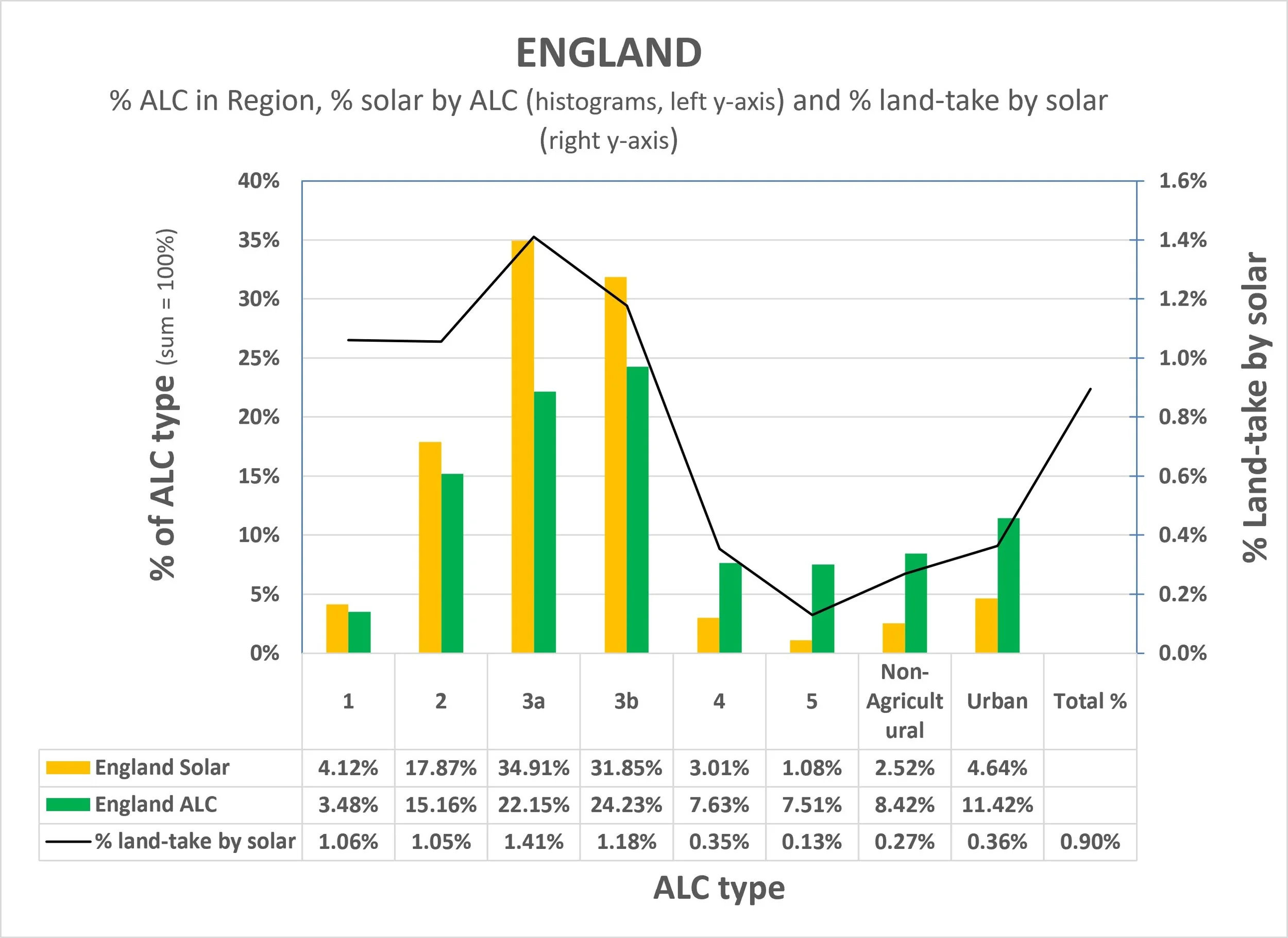
For England as a whole, the percentages of ALC Grades 1 to 5 are 3.5%, 15.2%, 22.2% (ALC Grade 3a), 24.2% (Grade 3b), 7.6% and 7.5% respectively. The remainder is either Non-Agricultural land (8.4%) or Urban areas (11.4%).
For ground-mounted solar installations across England as a whole, the percentages on ALC Grades 1 to 5 are 4.1%, 17.9%, 34.9% (ALC Grade 3a), 31.9% (Grade 3b), 3.0%, and 1.1% respectively, with 2.5% on Non-Agricultural land and 4.6% in Urban areas.
The total UK capacity of all ground-mounted solar installations is currently c. 67,360MW, or 67.4GW. The Government’s aim to increase the total amount of operational solar installations up to 75GW by 2035 (85GW including rooftop solar) means that more land will be needed in the future for this renewable energy source.
Unless the present recommendations are much more actively enforced, or unless new legislation is introduced to protect productive land (e.g. including more land in the BMV category) we will continue to see encroachment of solar on land that is best used for growing food. A developing food crisis, recently declared a national security concern, will not be averted by losing yet more land to solar.

Agricultural Land Classes of Solar Installations by Region
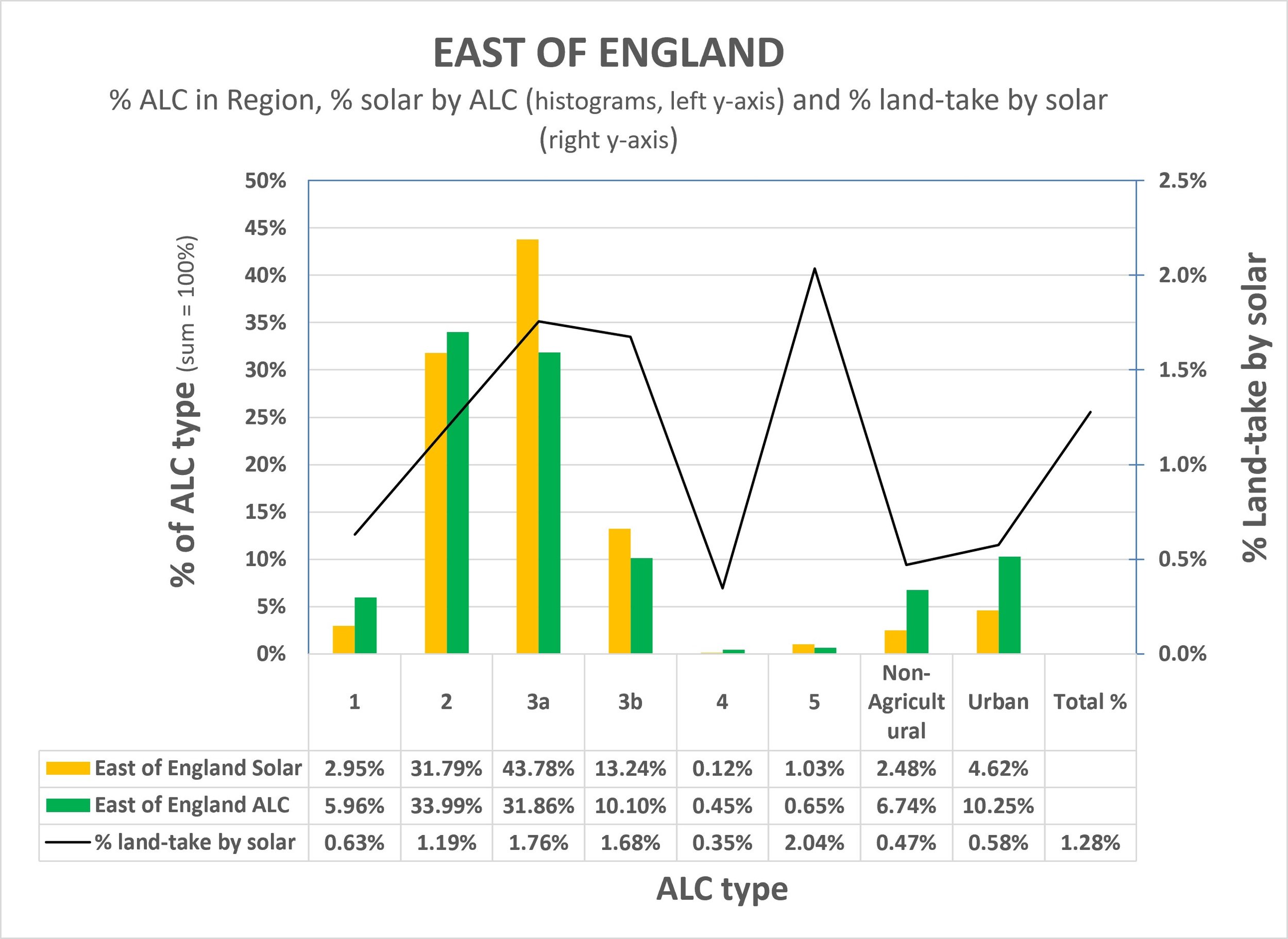
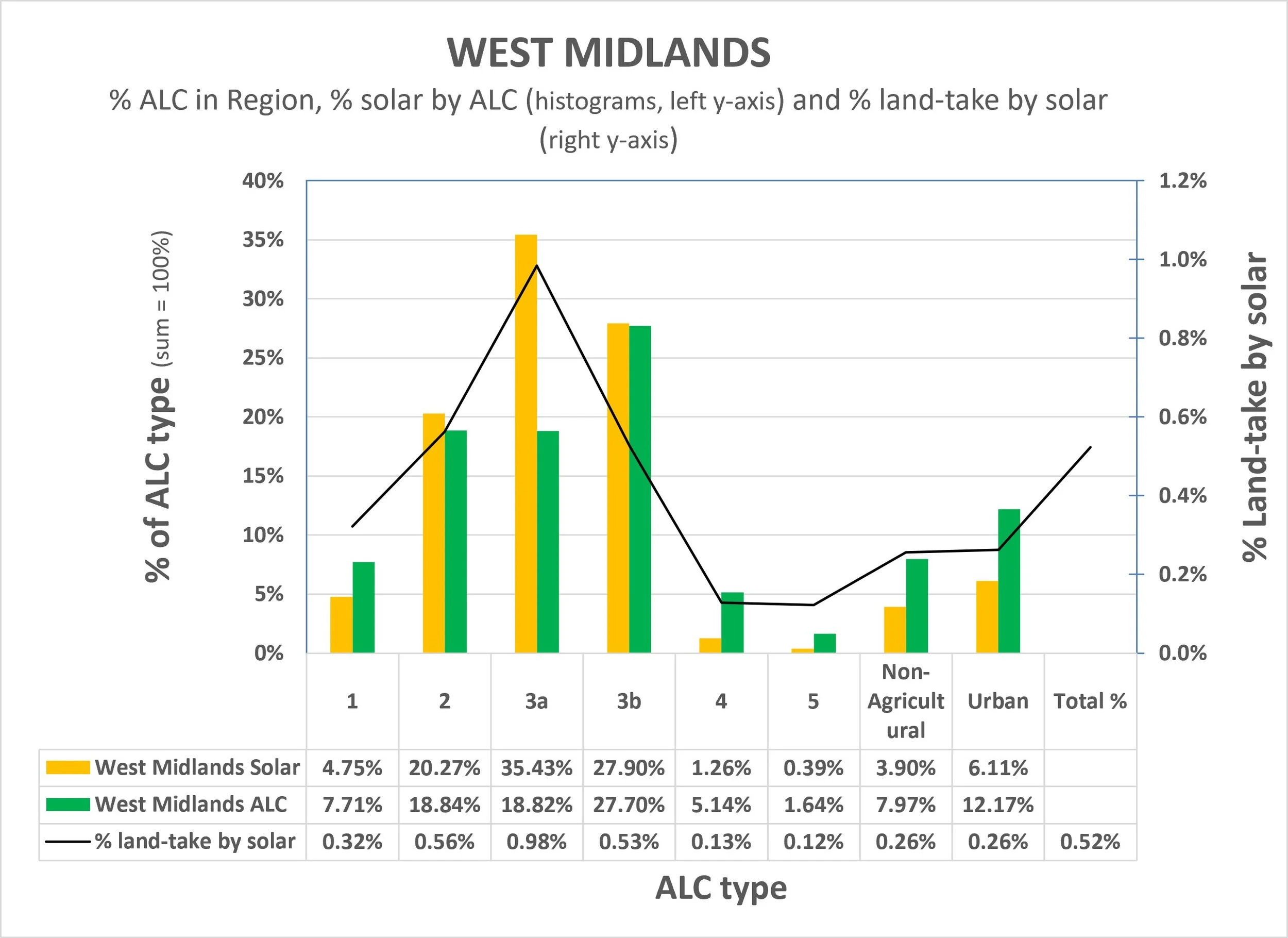
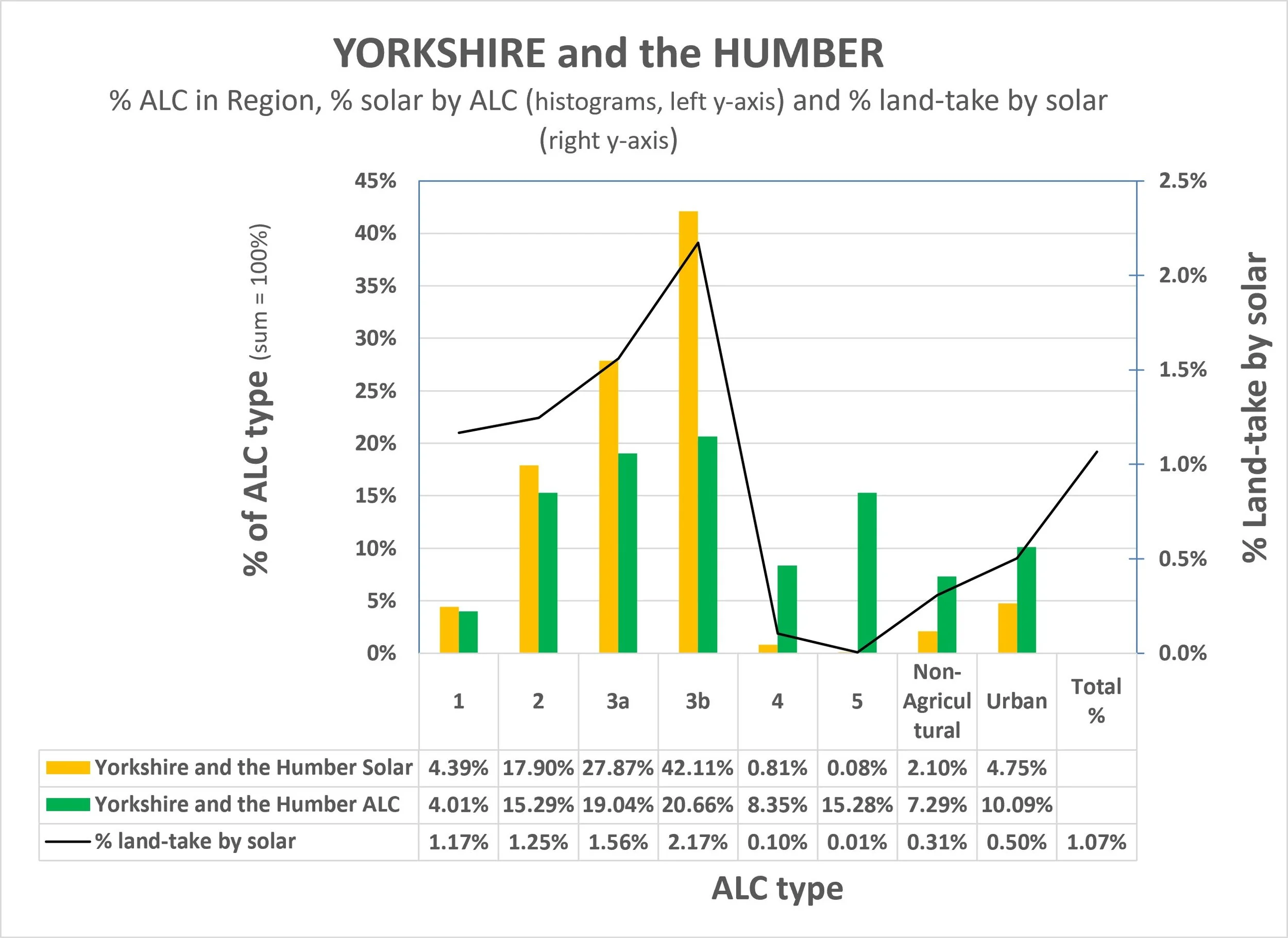
The images below present the ALC grades in each of the nine English Regions. The percentages of the different ALC grades in each region are shown by the green histograms. The percentages of the different ALC grades in the solar installations in that region are shown in yellow/gold (left-hand vertical axis in both cases). Each set of histograms adds up to 100%.
The percentage of each land class that will be occupied by solar is shown by the thin black line (right-hand vertical axis), with the overall (area-weighted) figure shown against the ‘Total %’ label on the horizontal axis.
Solar land-take of BMV land (ALC Grades 1 to 3a) is higher than that of non-BMV land (ALC Grades 3b to 5) in six out of eight English Regions (the ninth Region, London, has no BMV land). All of this development has been piece-meal, with no overall strategic spatial plan.
Nationwide, solar installations are ignoring recommendations to use poorer quality farmland (especially the poorest quality Grade 5 land), and are instead using disproportionately more good quality farmland. This is not for lack of poor quality land in each region; the thin black lines show that solar is taking only a small percentage of this sort of land. To lose any BMV land to solar threatens national food supplies and therefore food security.
Use the left/right arrows to see the results for the different Regions, below.
England
East Midlands
East of England
London
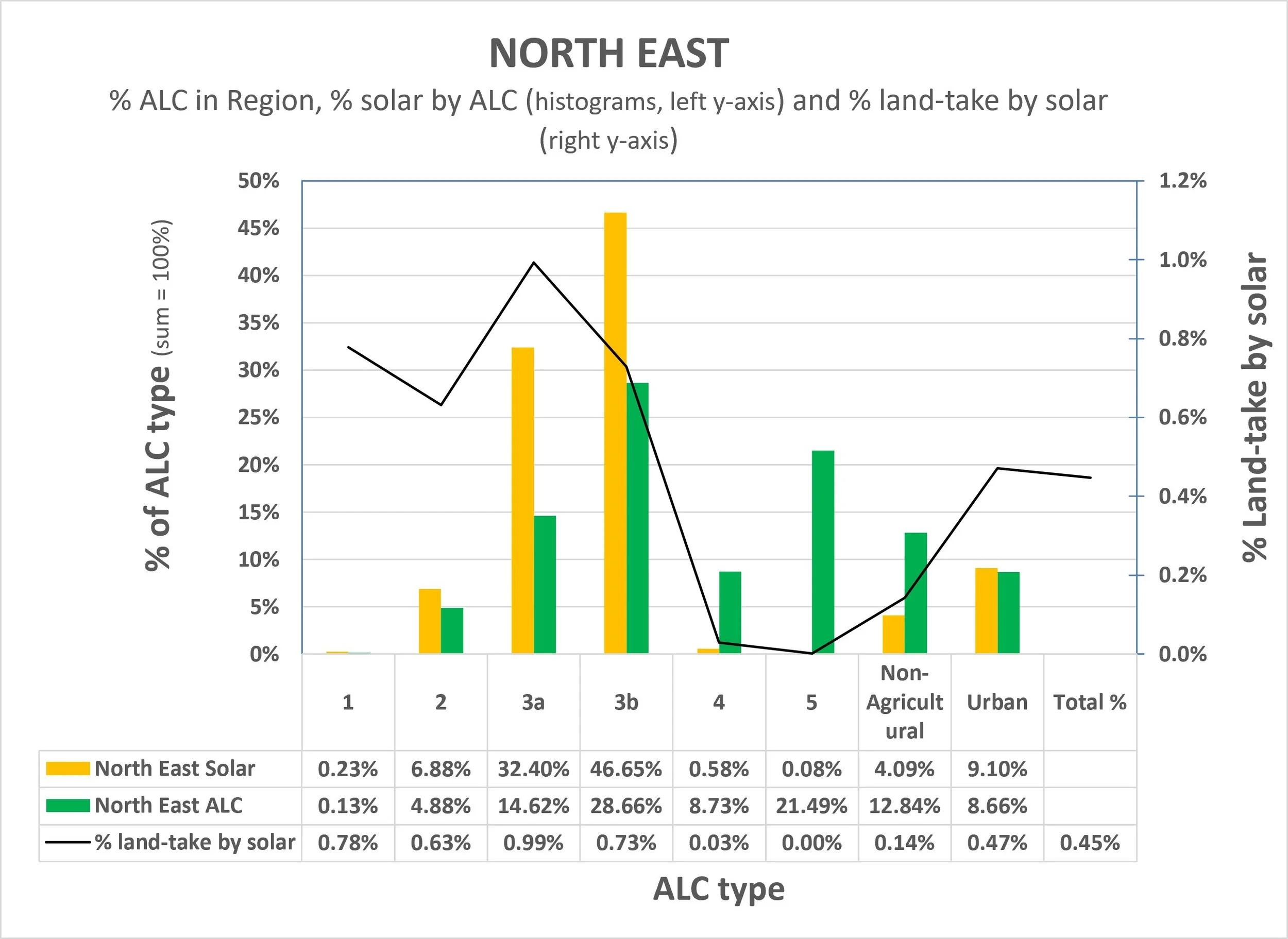
North East
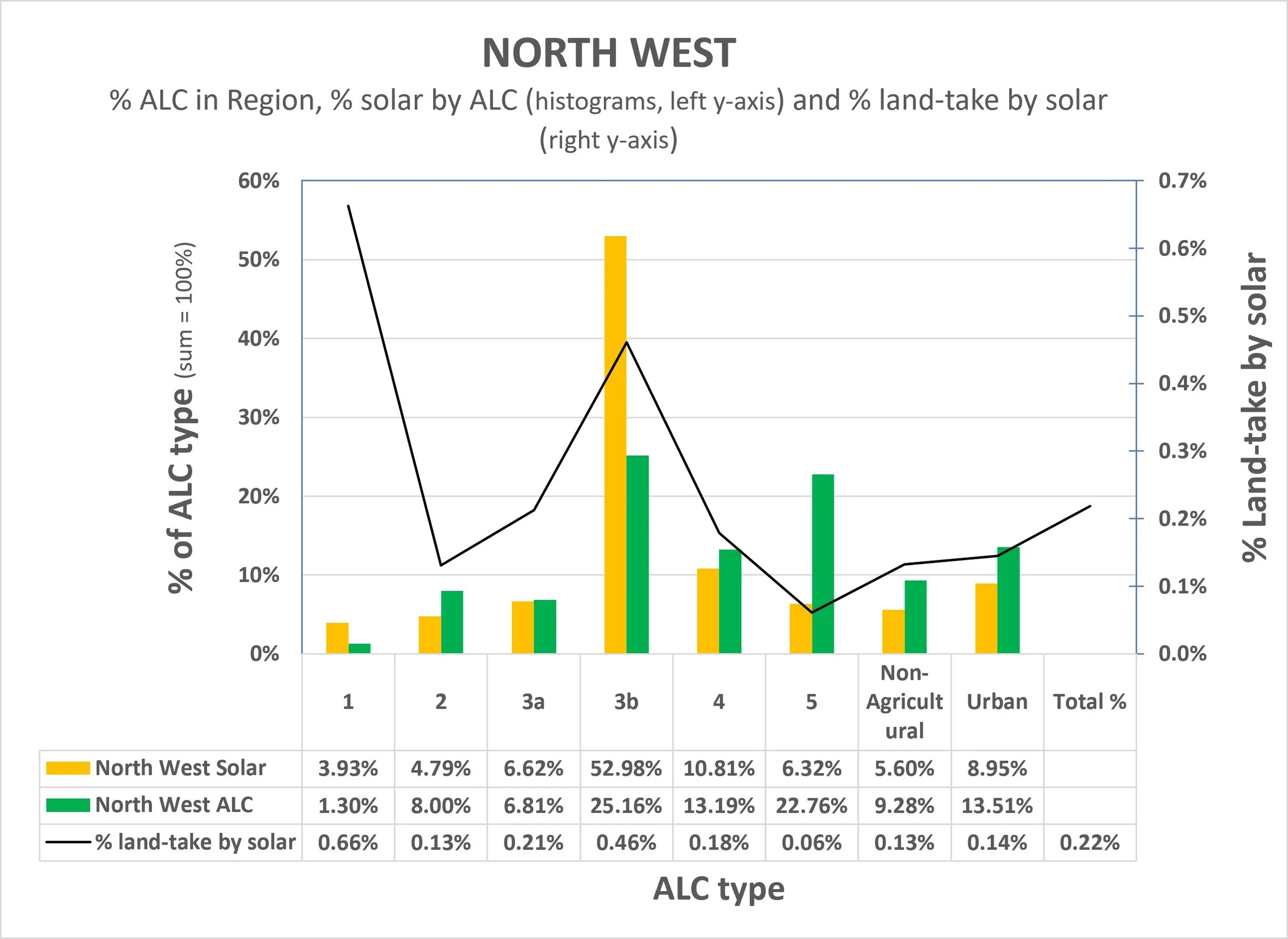
North West
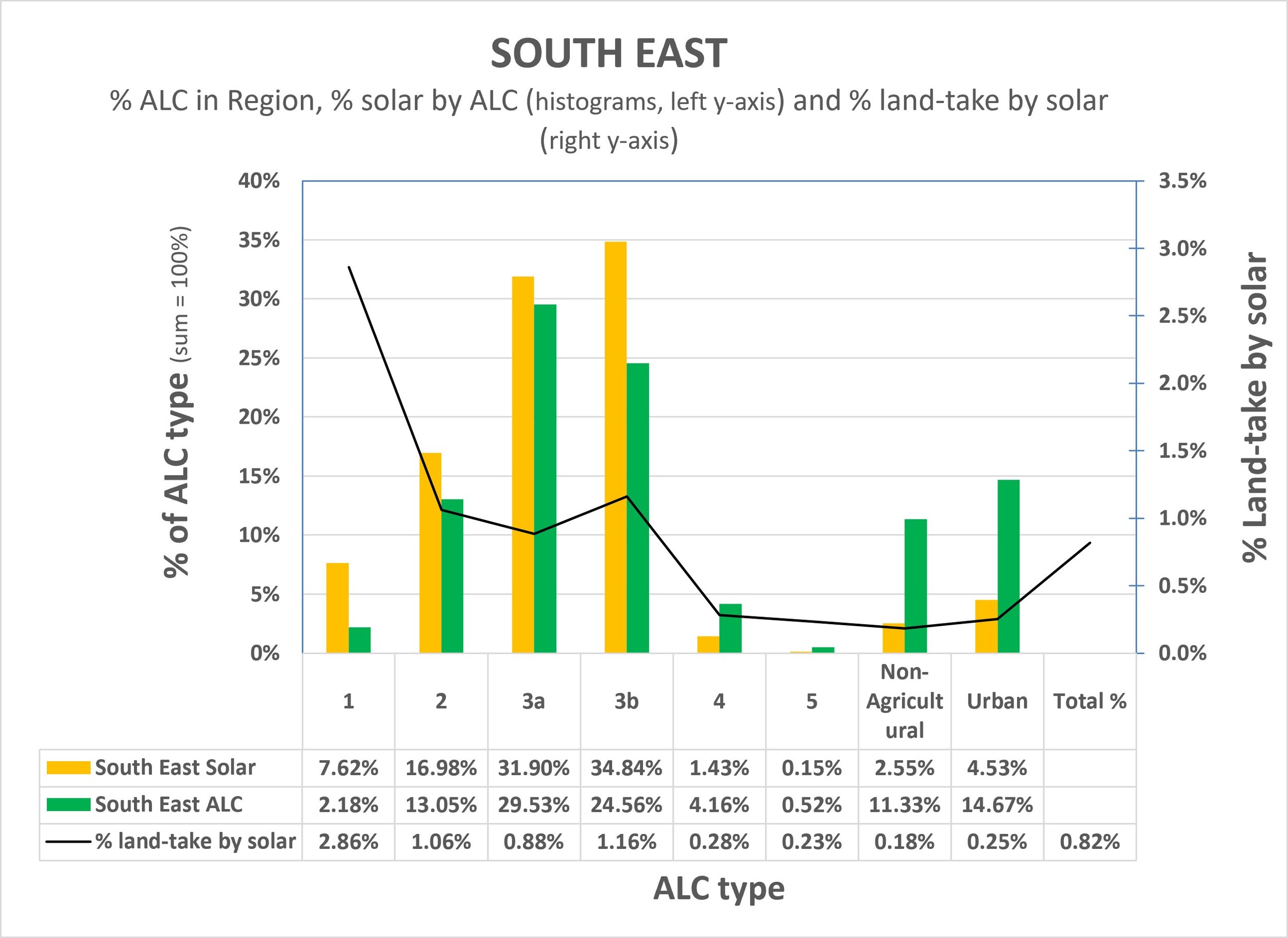
South East
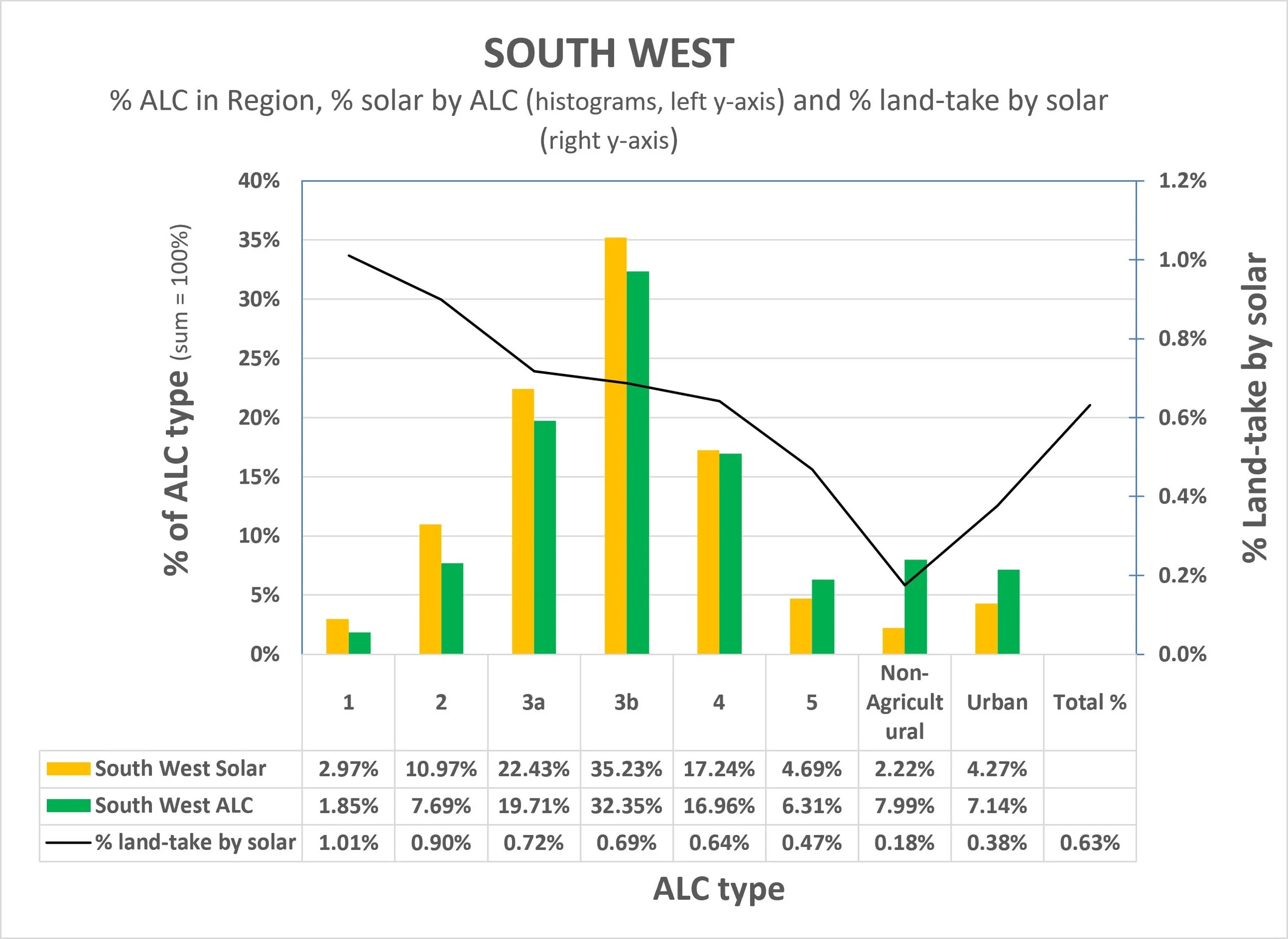
South West
West Midlands
Yorkshire and the Humber